
Health check-ups: what is a check-up and how do you choose the one that suits you best?
A health check, or check-up, is a preventive assessment of your health status that is carried out even when a person has no pronounced complaints.

A one-size-fits-all check-up that offers everyone an identical set of tests is not always the most appropriate solution. The need for preventive tests and how often they are done differ between groups of people, and international prevention guidelines also take into account age, sex, and behavioural and biological risk factors.
What is a health check-up?
A health check, or check-up, is an opportunity to assess your health preventively, even if you have no pronounced complaints. In modern preventive medicine, an individualised approach that takes into account a person's age, medical history, lifestyle and potential disease risks is becoming increasingly important.
Anti-Aging Institute goes a step beyond the usual check-up by offering a health assessment based on the principles of personalised medicine. Its aim is not only to check health indicators but also to understand each person's individual needs, identify risks in good time and develop a well-founded long-term plan for maintaining health.
Why doesn't a universal check-up suit everyone?
Two people of the same age may need very different health checks. One may have a family history of early cardiovascular disease, another of cancer or diabetes. One person has a sedentary job and little physical activity, while another trains intensively. Medication use, body weight, sleep, smoking, alcohol consumption, previous illnesses and the results of tests already performed may also differ.
That is why the need for tests is best assessed in context rather than on the principle of “the more tests, the better”.
Unnecessary tests do not always provide additional benefit. In some cases, they can lead to incidental findings or false-positive results that require further testing. That is why, in preventive medicine, what matters is not only the possibility of testing something but also a clear medical rationale – why this particular test is necessary for this person and what we will do with its result.
How does a doctor determine which health checks you need?
A personalised health check begins not in the laboratory but in a conversation with a doctor. The doctor assesses several interrelated factors.
Age and sex. The risk of certain diseases and the need for preventive checks change at different stages of life.
Family history. If close blood relatives have had cardiovascular, oncological, metabolic or other serious diseases, this may affect the prevention plan.
Personal medical history. Previously diagnosed conditions, surgeries, medications and the results of earlier tests help to identify which aspects of health need closer attention.
Lifestyle. Diet, physical activity, sleep, stress, smoking and other daily habits can make up a significant part of the overall risk.
Current well-being. Even seemingly minor complaints, such as persistent fatigue, sleep disorders or changes in exercise tolerance, are important to discuss with a doctor.
Previous tests. If a test was performed recently and the result was normal, there is not always a reason to repeat it.
In the personalised Anti-Aging Concept at Anti-Aging Institute, the doctor assesses complaints, medical and family history, diet, physical activity, daily routine and other individual health risks, and only then draws up a diagnostic plan.
Which health checks are important even if nothing hurts?
Prevention is essential precisely because some health risk factors may not cause noticeable symptoms at first. For example, the National Health Service in Latvia provides a state-funded preventive examination by a family doctor for people who have not visited their family doctor due to illness during the year. During the examination, the doctor may assess blood pressure, pulse, weight and other health indicators.
At certain ages, the state also covers specific preventive tests. Latvia runs cervical, breast, colorectal and prostate cancer screening programmes.
Diabetes risk assessment is also linked to age and individual risk factors. The NVD provides for glucose tests at certain ages, but people with increased body weight and additional risk factors may need to be tested more often.
This illustrates a key principle of preventive medicine – tests should be chosen based on risk, not just on how comprehensive a package you can buy.
Are blood tests enough for a full health check?
Blood tests can provide a lot of valuable information, but they are only one part of a health assessment. A laboratory value must be interpreted together with the person's age, medical history, medications, symptoms and other tests. For example, a single slightly abnormal value does not necessarily indicate a disease in itself. Conversely, normal test results do not rule out all health problems.
That is why, after a check-up, the doctor's interpretation of the results is essential – not just receiving a laboratory printout.
A good question to ask after a health check is not only “are my results within normal limits?” but also: what do these results mean for me specifically, what are my most significant risks and what should be done next?
How does a check-up differ from a preventive examination by a family doctor and the OVP (mandatory health examination)?
These services are not the same.
Individual check-up | Preventive examination by a family doctor | Mandatory health examination (OVP) | |
Main purpose | Assessment of individual health risks | General preventive health assessment | Fitness for a specific job and its occupational risks |
Scope of tests | Tailored individually | Depends on the doctor's assessment and the state programme | Depends on occupational risk factors |
Intended for | People who want a broader preventive assessment | Residents of Latvia in accordance with NVD conditions | Employees referred for the examination by their employer |
What happens after the examination | Interpretation of results and an individual action plan | Family doctor's recommendations and referrals if needed | Opinion on fitness for work |
The mandatory health examination, or OVP, is not a universal health check-up. Its purpose is to assess an employee's health in relation to the risks of a specific job, and its scope is determined by the occupational risk factors specified in the employer's referral.
What matters most after you receive your health check results?
The value of a check-up does not end when you receive your test results. On the contrary – interpreting the results and planning the next steps is one of the most important parts of a health check. After the results are in, the doctor should help you understand:
· which results are normal;
· which values need to be monitored;
· whether additional tests are needed;
· whether a consultation with another specialist is needed;
· which risk factors can be changed;
· when specific tests should be repeated;
· which lifestyle changes may be justified in your particular situation.
If changes are detected, the check-up itself is not treatment. It is a starting point for further medical assessment or a health plan.
How does a health check work at Anti-Aging Institute?
The personalised approach at Anti-Aging Institute is designed so that tests are linked to each individual's health situation.
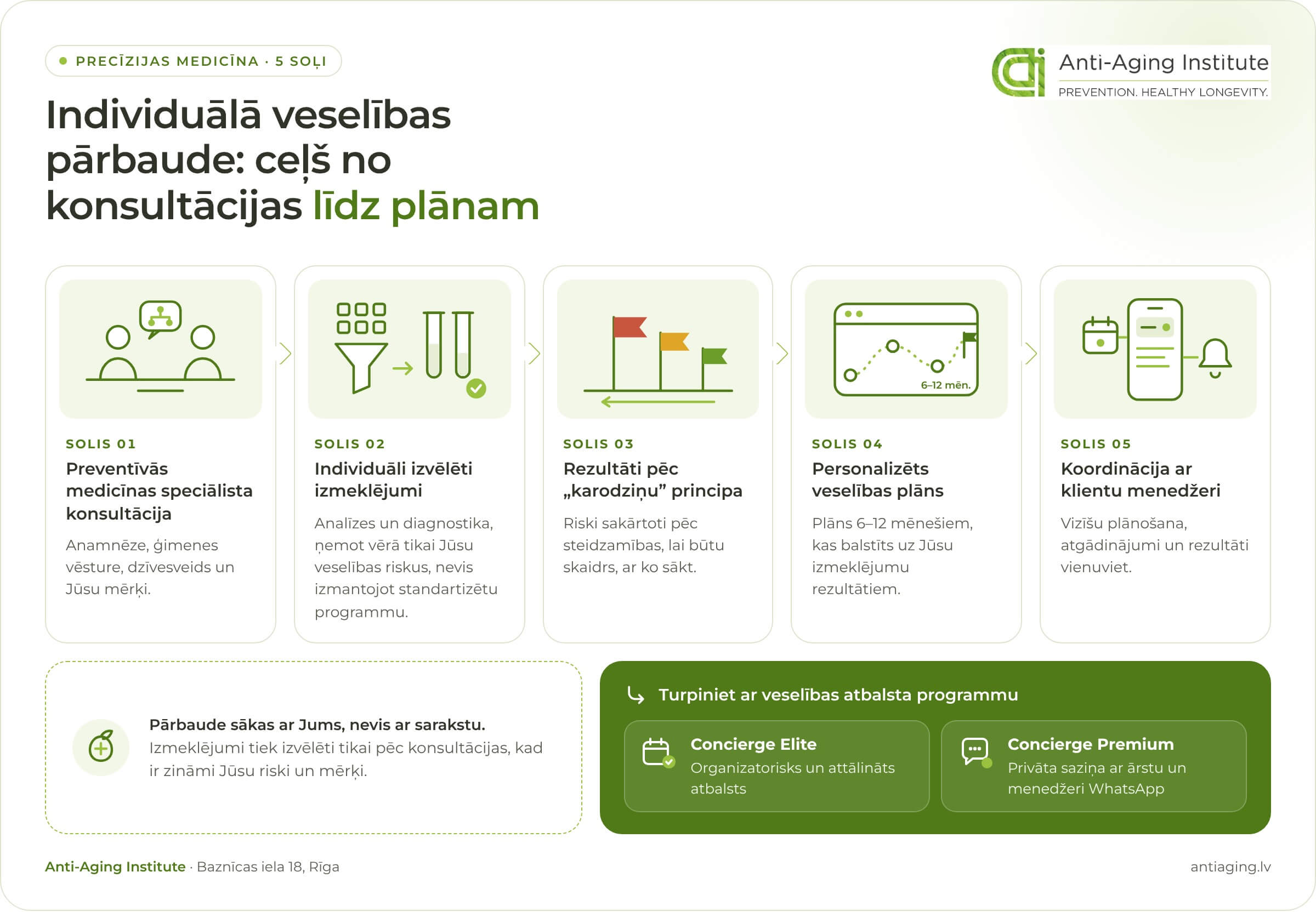
1. Assessment of health goals and medical history
First, we establish why the client wants a check-up – for prevention, because of a family history of disease, to assess specific health risks or to create a long-term health plan.
A preventive medicine specialist assesses the medical and family history, lifestyle, diet, physical activity and other factors affecting health.
2. Individually selected tests
Based on the initial assessment, the doctor determines the necessary laboratory and diagnostic tests and, if needed, consultations with other specialists.
This way, tests are chosen according to individual risk rather than from a ready-made list.
3. Evaluation of results
Once the necessary tests have been performed, the results are evaluated as a whole. If necessary, priorities are set for further diagnostics or health monitoring.
4. Action plan
Within the personalised Anti-Aging Concept, a long-term health plan can be created after the assessment. Doctors of various specialties and other healthcare professionals may be involved in implementing it.
5. Concierge programmes: support even after your health plan is created
Concierge programmes help you implement your health plan throughout the year. Concierge Elite provides organisational and remote support. A client manager coordinates appointments and recommends specialists, you can receive prescriptions and referrals remotely, and your questions are answered without a visit to the clinic. Concierge Premium additionally offers private 24/7 WhatsApp messaging with the lead doctor and a client manager, as well as consultations in case of illness. Elite takes care of the organisational side, while Premium lets you contact your doctor directly.
Elite | Premium | |
Price | 60 €/month or 365 €/year | 300 €/month |
Appointment booking | Yes | Yes, including adjustment of the visit schedule |
Prescriptions and referrals | Yes, remotely | Yes |
Health questions | Answer within one working day | Private WhatsApp messaging with the lead doctor and manager |
In-person consultation | Not included | One consultation per month with the lead doctor |
Manager support | Weekdays 9.00–17.00 | WhatsApp 24/7 |
Personalised Anti-Aging Concept or Health Check Express Programme – which should you choose?
Anti-Aging Institute offers different health assessment models, so the choice depends on what you want to achieve.
Criterion | Personalised Anti-Aging Concept | Health Check Concept Express Programme |
Main purpose | In-depth assessment of health risks and a long-term health strategy | Comprehensive health check in a concentrated time frame |
Approach | Individually tailored, based on the principles of precision medicine | Structured diagnostic programme |
Start of the process | In-depth consultation with a doctor and assessment of medical and family history | Pre-structured programme of tests and consultations |
Tests | Selected after assessing individual risks and health needs | The programme includes laboratory tests and diagnostic examinations |
Specialist involvement | According to individual need | Specialist consultations included in the programme |
Duration | Individual process with a possible 6–12-month health monitoring period | Tests completed within approximately 6 hours |
Result | Individual health profile and long-term action plan | Doctor's evaluation of the results and recommendations |
Best suited for | People who want an in-depth understanding of their health risks and to plan for maintaining their health in the long term | People who want a structured health check within a limited time |
Personalised Anti-Aging Concept
This approach is more suitable if you want to:
· assess your individual health risks in depth;
· start with a doctor's consultation and only then determine the tests;
· assess your family history;
· bring several health issues together in a single plan;
· receive a long-term health monitoring and action plan.
In the Anti-Aging Concept, a health profile and a long-term action plan are created after the consultations and necessary tests; the monitoring period is 6–12 months on average.
Health Check Concept Express Programme
The express programme is more suitable for people who want to complete several tests and consultations in a concentrated time frame. The programme combines laboratory tests, diagnostic examinations and specialist consultations, and at the end the concept's lead doctor evaluates the results and provides recommendations for further care. The current programme model provides for the tests to be completed within approximately six hours.
So the difference is not a “better or worse check-up”. What differs is the purpose and the depth of the process.
If what matters most to you is an in-depth long-term health plan that is individualised from the outset, the personalised concept may be more suitable. If your priority is to complete an already structured diagnostic programme in a limited time and then receive a doctor's evaluation, the express programme may be more practical.
When should you not wait for a scheduled health check?
A check-up is primarily intended for preventive health assessment. If you develop new or pronounced complaints, such as persistent pain, unexplained weight loss, bleeding, significant changes in how you feel or other alarming symptoms, you should not wait until your next preventive check. In such a situation, you need a consultation with an appropriate doctor and targeted diagnostics.
In an acute or life-threatening situation, seek emergency medical help.
In the Veselības centrs 4 podcast episode “Prevention as a superpower – why take care of your health before symptoms appear?”, preventive medicine specialists Dr Jūlija Balandina and Dr Žanna Al Suleimane explain why health checks are important even for people without pronounced complaints and how individual risks, family history, diet, physical activity and other lifestyle factors shape an overall prevention plan.
Frequently asked questions about health checks
What is a health check-up?
A check-up is a preventive health examination that may include a doctor's consultation, laboratory tests, diagnostic examinations and, if necessary, specialist consultations. The scope of tests should ideally be tailored to your age, medical history and individual risks.
Do I need a health check if I feel well?
Preventive checks are also intended for people without complaints. In Latvia, the NVD provides several preventive measures for people without symptoms, including a preventive examination by a family doctor and screenings for certain age groups.
Which tests should be done preventively?
There is no single set of tests that suits everyone. The choice depends on your age, medical history, family history, lifestyle, medications and previous results. That is why it is best to consult a doctor first.
Does having more tests make me more certain about my health?
Not always. Tests should be medically justified. Unnecessary tests can also lead to incidental findings and false-positive results, resulting in further diagnostics.
How does a check-up differ from the OVP?
A check-up is a preventive assessment of your health status. The mandatory health examination, or OVP, on the other hand, relates to the risk factors of a specific job and working environment, and its scope is determined by the employer's referral.
Are blood tests enough for a full health check?
Usually not. Blood tests are an important part of diagnostics, but the results must be evaluated together with your medical history, a physical examination by a doctor and, if necessary, other diagnostic tests.
How often should I have a health check-up?
There is no universal interval. The frequency of different tests varies depending on age, individual risk and previous results. We recommend discussing a specific schedule of preventive checks with your doctor.
What happens if a health check reveals abnormalities?
The doctor assesses the significance of the finding and, if necessary, recommends additional tests, diagnostics, a consultation with another specialist, treatment or follow-up monitoring. A single abnormal test result does not necessarily mean a diagnosis.
What is the difference between the personalised Anti-Aging Concept and the express programme?
The personalised Anti-Aging Concept begins with an assessment of your individual health risks and medical history, after which a diagnostic and long-term health plan is created. The express programme is a structured check in which several tests and consultations are concentrated within approximately six hours, followed by a doctor's evaluation once the results are available.
Where in Riga can I have a personalised health check?
Anti-Aging Institute is located at Baznīcas iela 18, Riga, and offers both the personalised Anti-Aging Concept and the Health Check Concept Express Programme. You can choose the most suitable approach depending on whether you need an individualised long-term health plan or a concentrated programme of preventive tests.
What is the difference between Concierge Elite and Concierge Premium?
In both health support programmes, you have your own client manager who books appointments, reminds you about check-ups and helps you implement your health plan. Concierge Elite provides organisational and remote support. Concierge Premium additionally offers private WhatsApp messaging with the lead doctor and consultations in case of illness.
Which health check is more useful for you?
Answer 5 short questions about your family history, how you feel and how much time you can devote to tests. The test takes less than a minute and will help you understand whether the Personalised Anti-Aging Concept with an individual plan or a one-day health check is more suitable for you.


Which health checks do you need?
Choose an individual plan that starts with a doctor's consultation, or a one-day health check.


